Building the Next Generation of Laboratory and Public Health Professionals
The Centre for Emerging and Re-emerging Infectious Diseases (CERID), LAUTECH provides advanced laboratory training services designed to strengthen scientific, diagnostic, genomic, and public health capacity in Nigeria and across Africa.
Our training programmes combine hands-on laboratory practice, modern molecular technologies, genomics and sequencing workflows, bioinformatics applications, quality management systems, and epidemiological interpretation to equip participants with competencies that are directly applicable to research laboratories, clinical diagnostics, disease surveillance, and outbreak response.
Training is delivered by experienced professors, molecular scientists, microbiologists, virologists, epidemiologists, biostatisticians, and bioinformatics specialists using CERID's modern laboratory infrastructure and computational facilities.
1 Who Can Participate?
Our laboratory training services are suitable for:
MSc, MPH, and PhD candidates in biomedical and public health disciplines.
Researchers seeking advanced molecular and genomic laboratory skills.
Professionals requiring competency updates and specialized diagnostics training.
Clinicians and public health practitioners involved in disease surveillance and response.
Staff from public health agencies, NGOs, and international health programmes.
University departments, laboratories, and research groups requiring customized training.
2 Core Training Areas
Molecular Diagnostics
PCR, real-time PCR, nucleic acid extraction, assay optimization, contamination control, and diagnostic interpretation.
Genomics & Sequencing
Oxford Nanopore workflows, library preparation, sequencing, quality assessment, and genomic surveillance applications.
Bioinformatics
Sequence analysis, phylogenetics, variant analysis, genome assembly, and data visualization.
Biosafety & Biosecurity
Risk assessment, PPE, waste management, laboratory containment, and safe handling of infectious materials.
Quality Management
SOP development, quality assurance, internal quality control, documentation, and accreditation preparedness.
Epidemiology & Statistics
Data management, outbreak analytics, biostatistics, and interpretation of laboratory and surveillance data.
3 Programme Formats
Short Courses
1-5 day intensive practical workshops for specific laboratory competencies.
Certificate Programmes
Structured multi-week training with practical assessments and certification.
Customized Training
Tailored programmes for institutions, laboratories, and public health agencies.
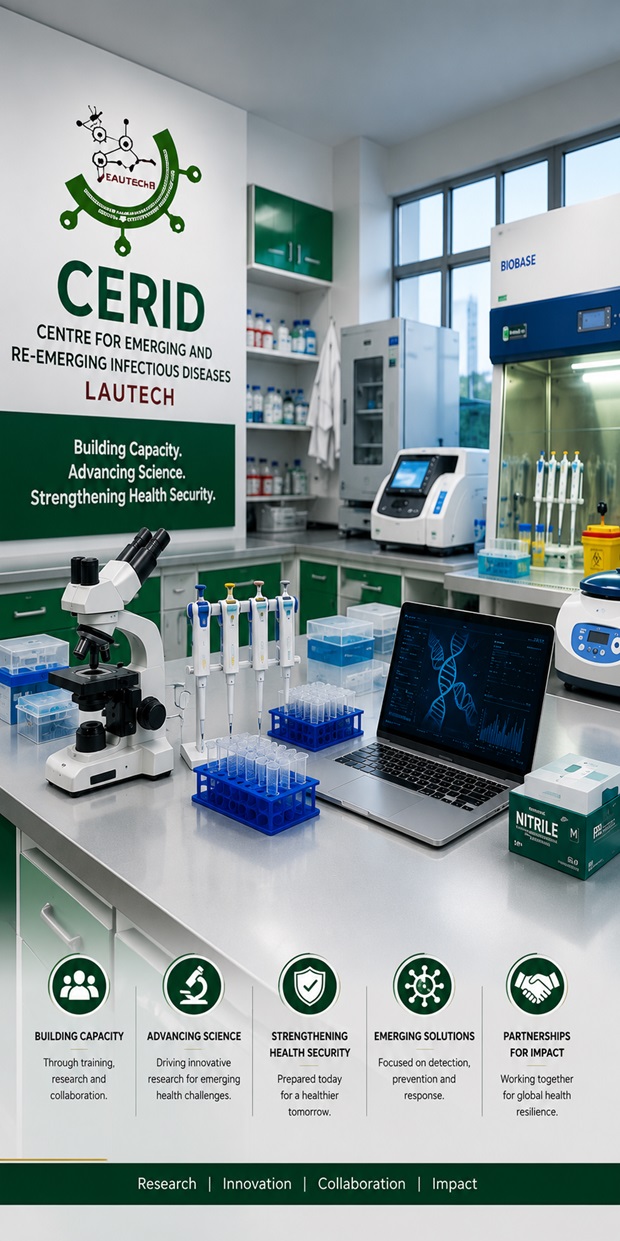
4 Hands-On Practical Experience
Participants receive supervised practical exposure to:
5 Learning Outcomes
Upon completion, participants will be able to:
- Perform molecular and genomic laboratory procedures competently.
- Apply biosafety and quality management principles.
- Generate and interpret laboratory and sequencing data.
- Use basic bioinformatics tools for pathogen analysis.
- Contribute to disease surveillance and outbreak investigations.
- Document and report laboratory findings according to professional standards.
6 Certification
Participants who successfully complete the required practical and assessment components receive an official CERID Certificate of Participation or Competency, which may be used for professional development, institutional reporting, and continuing education purposes.
7 Why Train at CERID?
Modern Laboratory Infrastructure
Access to contemporary molecular, genomic, and computational facilities.
Expert Faculty
Training delivered by professors and specialists with active research and public health experience.
Practical Emphasis
Strong focus on hands-on skills rather than theory alone.
Research Integration
Exposure to ongoing infectious disease and genomics research activities.
Request Laboratory Training
Institutions, research groups, laboratories, and individual professionals may request customized laboratory training, workshops, internships, or technical capacity-building programmes.